Another future answers "What if X happens?" Name a shock and its size; Amten carries it through a world model of companies, sectors and funds linked by customers, suppliers and exposures, and shows the path, who it reaches first, and whose story breaks. In the illustrative NVIDIA story, a 20% fall in cloud capital spending cuts revenue about 14% in the first year, and a one-point rise in the discount rate lifts what the price needs from 31% to 34% a year. Every story ends on three endings, with how far the evidence leans to each.
Shock, path, reach, break
A what-if has four parts. The shock is a change with a size: cloud capital spending −20%, rates +1 point, oil +$20. The path is how it travels: through customers, suppliers, shared exposures and fund holdings. The reach is who it touches and in what order. The break is whose story no longer holds once it arrives.
The world model links US-listed companies, sectors and ETFs through filed customer shares, supply relationships and exposures. The first ring uses filed figures; outer rings are judged, not measured, and the beat says which is which.
- Name the shock and its size: "What if cloud capital spending falls 20%?"
- Optionally set the scope: one company, a sector or a fund.
- Read the price shown, confirm, and the branch streams in as new beats.
- Open "Hurt most" and "Helped most" to see who the shock reaches, ranked by effect.
The ripple: cloud spending −20%
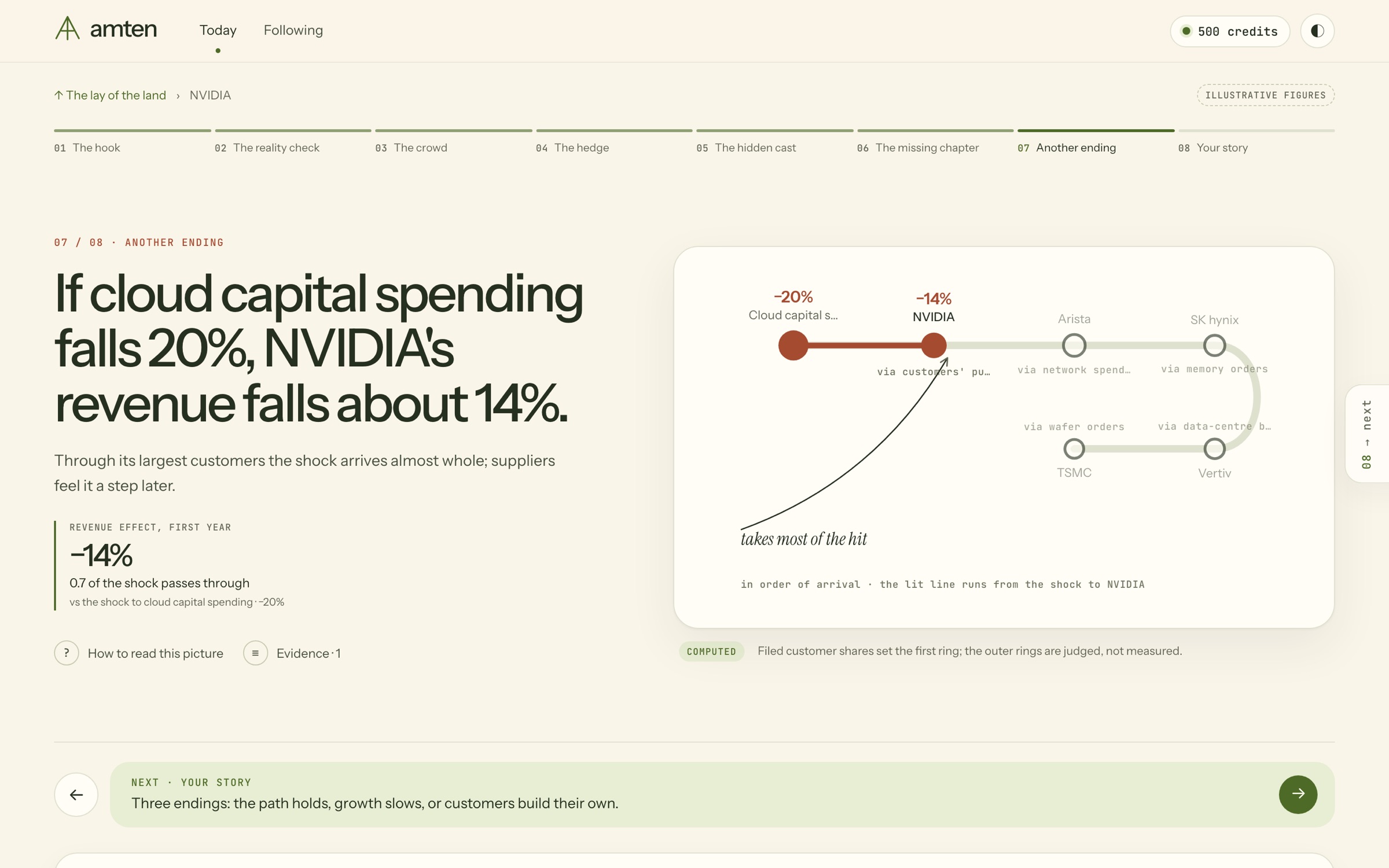
In the illustrative case, if cloud capital spending falls 20%, NVIDIA's revenue falls about 14% in the first year: 0.7 of the shock passes through, because its largest customers are the cloud companies themselves. Suppliers such as the foundry and memory makers feel it a step later; networking and data-centre power names sit on the outer rings.
The picture lights the path hop by hop, so the order of arrival is as visible as the size.
Three endings and the base rate
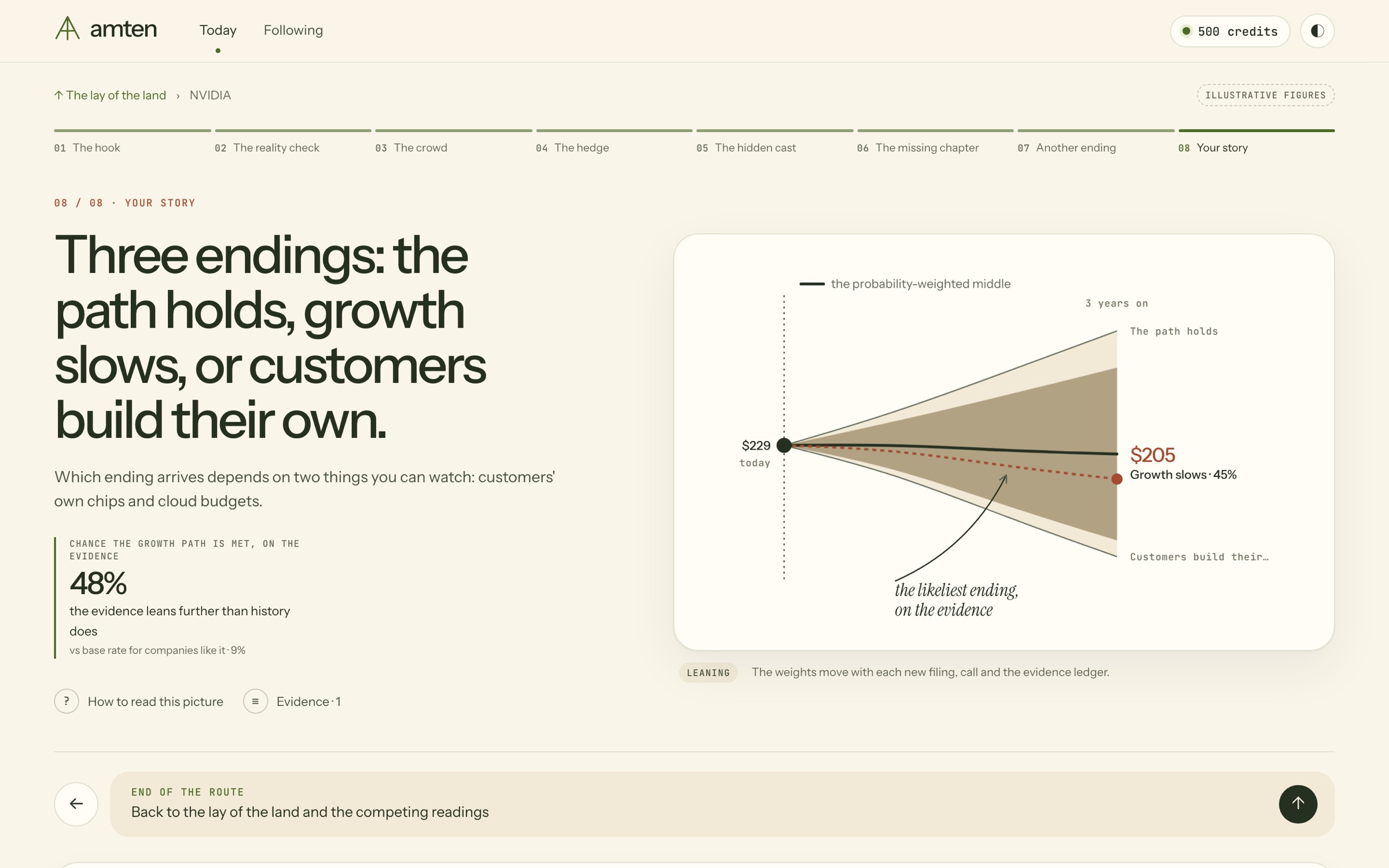
Every company story closes on three endings: the path holds, growth slows, or a named risk takes over (here, customers build their own). The picture is a fan from today's price, with the probability-weighted middle marked. The weights are a standard 30/40/30 starting point, not a forecast of which ending arrives.
The number that matters is beside it: on the evidence, the chance the growth path is met is 48%, against a 9% base rate for companies like this. The evidence leans further toward the path than history does, and the beat says which two things you can watch to see which ending is coming: customers' own chips, and cloud budgets.
The rates +1 point example
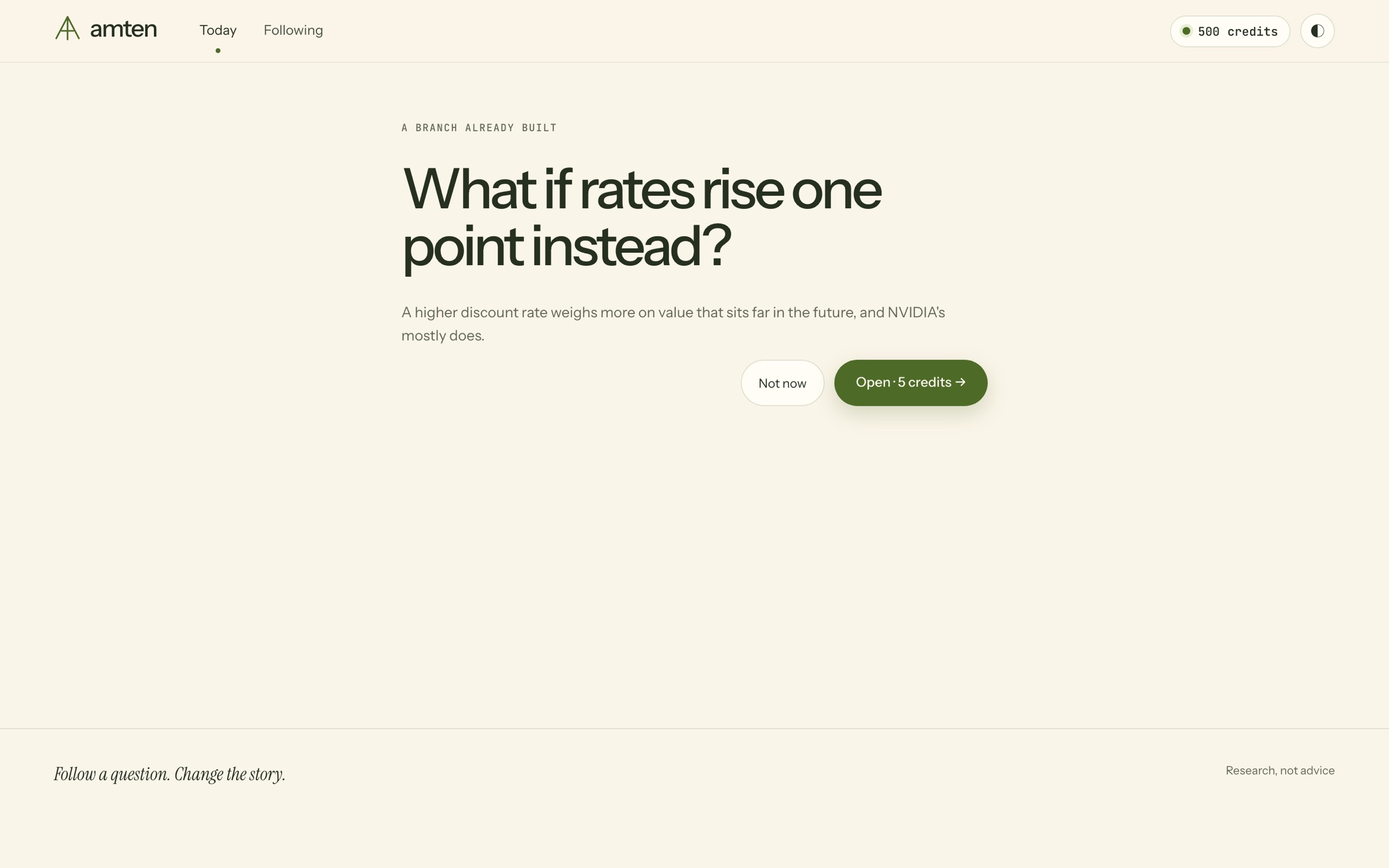
Discount rates hit long-duration stories hardest, because more of their value sits far in the future. Ask "What if rates rise one point?" on the illustrative NVIDIA story and a pre-built branch answers: a one-point rise in the discount rate cuts the value the evidence supports by about 12%, and what the price needs rises to 34% a year, from 31% before.
Because the branch was already built for this story version, it opens at about 5 credits. The button says "Open · 5 credits" before anything runs.
How the storyline changes
A what-if is a branch: a story of its own with the parent in its breadcrumbs, shown on the parent's map as a new entrance. It re-runs the beats the shock touches. What the price needs is recomputed, the readings are re-judged, and the three endings are redrawn.
Compare the branch with the parent and the change is the point. A rates shock that lifts the requirement from 31% to 34% makes "A five-year duration bet" harder to win; a spending shock that cuts revenue 14% gives "Customers becoming competitors" a second route to the same ending.
Common questions
Is a what-if a prediction?
No. It is a conditional: if this shock arrives at this size, here is how it travels on the links Amten can measure or judge. The shock's likelihood is not part of the answer.
Why are the outer rings less certain?
The first ring uses filed customer and supplier shares. Further rings rely on judged exposure, so their effects carry wider bands and are labelled as judged.
Can I run a what-if on a sector or a fund?
Yes. Scope a shock to a company, a sector such as energy, or an ETF such as XLE; the reach is then ranked across its members or holdings.
What does a what-if cost?
A branch someone already built for the same story version costs about 5 credits. A new one shows its estimate first, typically about 99 credits and at most 150.