The missing chapter asks what the price has not caught. Amten looks at the hidden cast (customer and supplier concentration from filings), early signals in alternative data such as job postings, contradictions between independent signal families, and filed items with no measured price reaction. A quiet price can mean the item went unnoticed, but it can also mean it was already known or judged immaterial, so Amten says "no measured price reaction" and never "the market missed it". Each clue ends in a test: what would confirm it, what would refute it, and when.
A missing chapter is a testable difference
A variant perception is a specific, evidence-backed difference from what the price appears to assume. "Great company" is not one. "The price needs 31% growth for five years while the four largest customers build substitutes" is, because it names a driver, a baseline and a mechanism that could be checked.
Amten's job here is to find candidate chapters and to say how firm each one is. It does not decide that the market is wrong; it shows where the evidence and the price may be telling different stories.
Early signals in alternative data
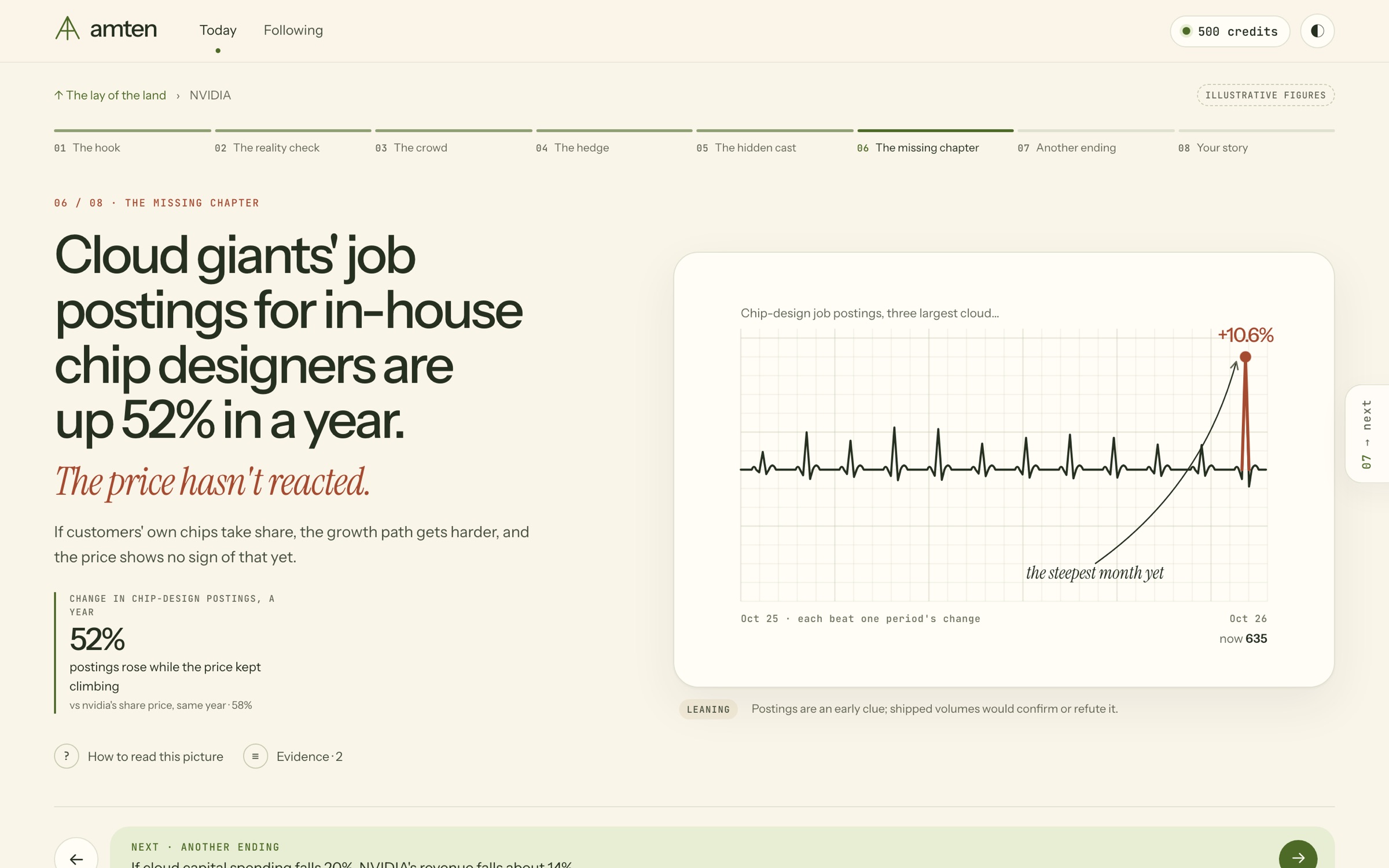
Some evidence shows up before the financial statements do. Job postings, patent filings, shipping and web activity can move months ahead of revenue. Amten draws the series against its own history and marks the point that matters.
In the illustrative case, cloud giants' postings for in-house chip designers are up 52% in a year, with the steepest month yet at +10.6%. Version 1 of the story said 40%; the figure moved, and the beat says so in "How this story changed". Postings are an early clue, not proof: shipped volumes would confirm or refute it.
"No measured price reaction", read carefully
For filed items such as an 8-K, a customer disclosure or an insider cluster, Amten measures the stock's abnormal move in the days around the date: the move beyond what the market and the stock's own volatility would explain. When that move is small, the beat says "no measured price reaction".
A quiet price has at least three explanations, and only one of them is a missing chapter.
- Not yet noticed: the item is new, obscure or buried in a long filing. This is the interesting case.
- Already known: the market expected it, or it leaked, so the price moved earlier and nothing was left to react to on the day.
- Judged immaterial: investors read it and decided it does not change cash flows enough to matter.
| Explanation | What would point to it |
|---|---|
| Not yet noticed | Little coverage, a later reaction when the item is repeated or quantified |
| Already known | A move before the filing date; earlier mentions in calls or estimates |
| Judged immaterial | No change in estimates or options pricing after the item is widely read |
Contradictions between signal families
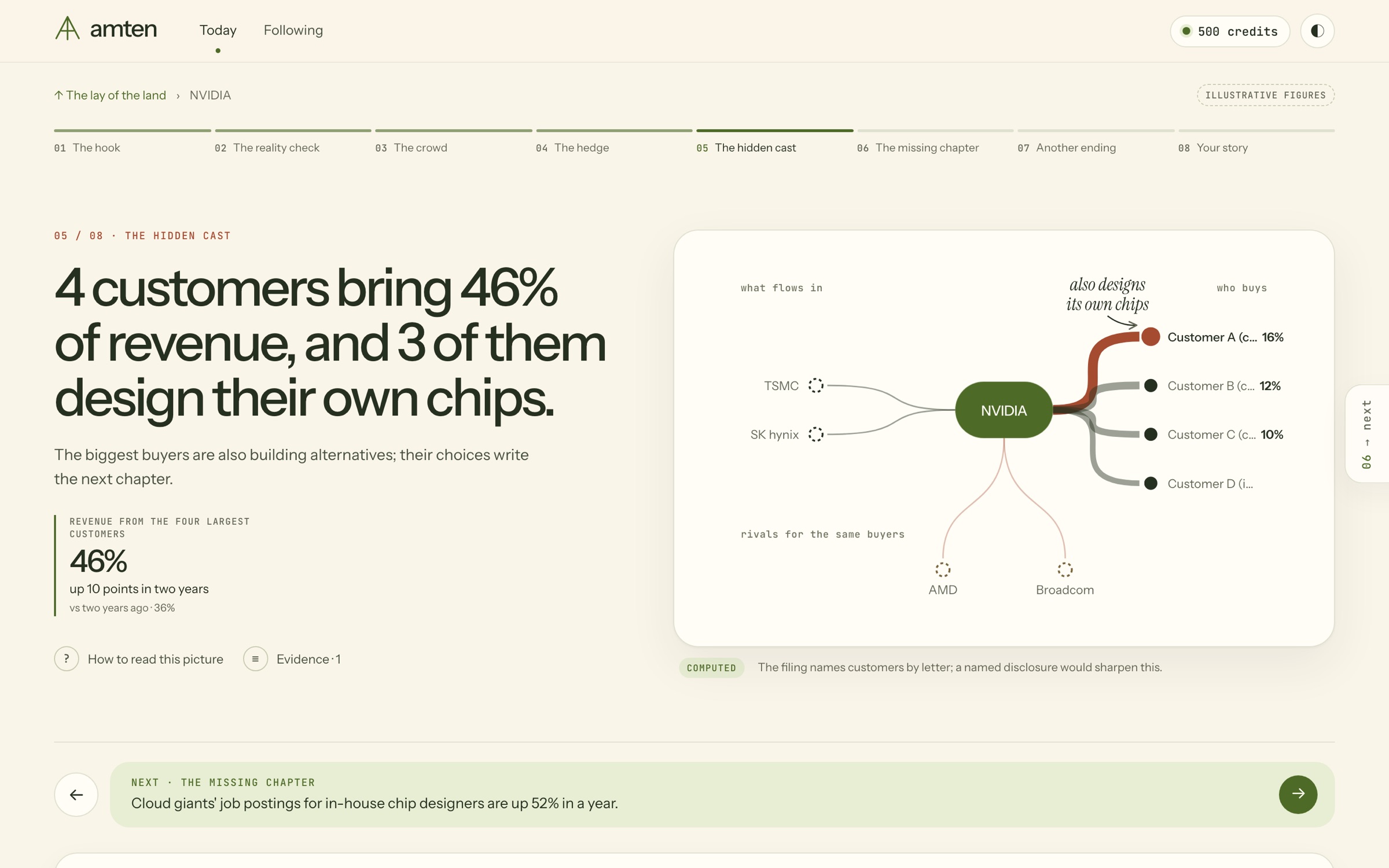
A clear disagreement is as material as agreement. When two independent families point opposite ways (owners arriving while protection gets pricier, revenue rising while receivables rise faster, a sector breaking out while its breadth narrows) Amten keeps both on the map and names the tension instead of averaging it away.
In the illustrative story, 412 managers arriving against 288 leaving sits beside downside insurance at 1.3 times upside. That pairing is what produces the reading "Confidence wearing a seatbelt", plausibility .40.
From clue to test
A clue earns its place when it says what would settle it. Ask a beat "What would show the chips are shipping?" and Amten builds a branch: in the illustrative case, "Customer B says its own chip already runs 18% of its AI workloads", with two dates to watch and one disclosure that would separate a hiring plan from shipped silicon.
Follow the story and the test watches itself: if the chip-design reading moves by .15 or more, a new version is written and you are told by how much.

Common questions
Does "no measured price reaction" mean the market missed something?
No. It means the stock's abnormal move around the item's date was small. The item may be unnoticed, but it may also have been known earlier or judged immaterial. Amten states the measurement, not a conclusion.
Is alternative data reliable?
It is early and noisy. Amten shows each series against its own history, says what would confirm it (usually a later filed figure) and keeps its confidence band wider than for filed numbers.
Can a missing chapter be negative?
Yes. A clue that growth, margins or duration may fall short of what the price needs is tested the same way as one that points the other way.
Where does customer concentration come from?
From the company's own filings, which disclose customers above a share of revenue, usually by letter. Amten sizes only what is filed and dots the rest.