In Amten, code computes every number and keeps its working, a classifier judges what needs judgment (how plausible a reading is, how firm a beat is), and the writing uses only facts that have already been verified. A number appears only with its working or its source. Every interpreted story has at least two competing readings, each with what would confirm and refute it. Amten never says buy, sell, hold, target or undervalued. Coverage is US-listed markets. The NVIDIA figures in these guides are illustrative.
Code computes, the classifier judges, the writing only reports
Three kinds of work, kept apart. Code computes: what the price needs, base rates, per-$100 figures, implied moves, ownership flows and what-if paths, each with a working you can open. A classifier judges what cannot be computed: a reading's plausibility, how firm a beat is, whether a day's candidate is newsworthy. The writing turns verified facts into short sentences and is not allowed to add any.
Before a story is stored, a validator checks every line: claims of at most 90 characters, at most three numbers per beat, every number present in its working or source, no advice words, no model or vendor names. A line that fails is replaced by a fixed template over the same figures.
Competing readings, never one answer
A price is compatible with several stories. Every story with an interpretation carries at least two readings, and each one names its mechanism, the beats for and against, and what would confirm or refute it. Plausibilities are judged one by one and are not forced to add up to 1.
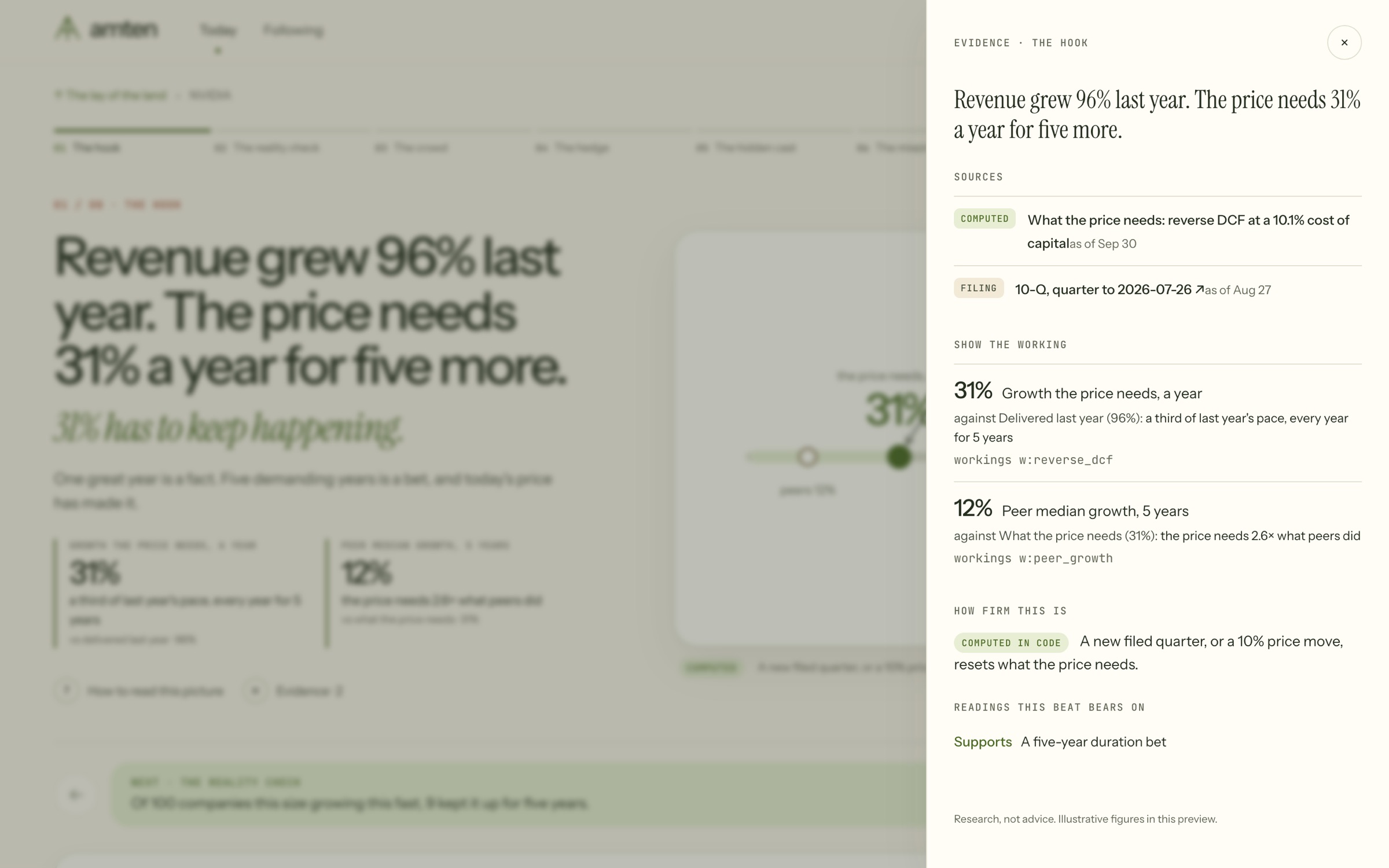
Readings are phrased as what the market may be pricing ("A five-year duration bet", .58), not as what is true.
How firm it is
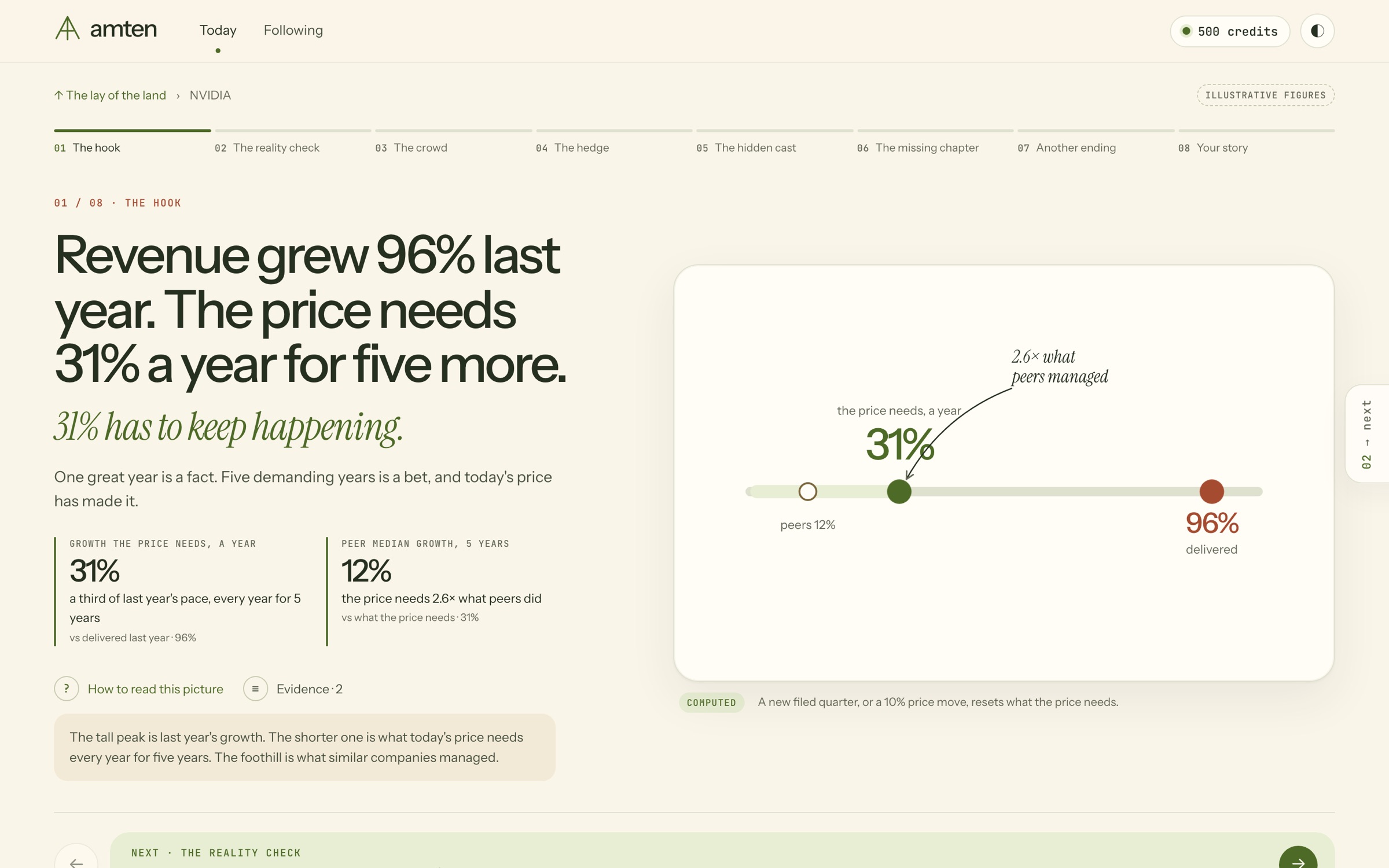
Each beat shows a confidence band and a line on what would change it. On the illustrative hook: "A new filed quarter, or a 10% price move, resets what the price needs." On the crowd beat: 13F filings are 45 days late, and the next quarter's arrive in mid-November. On an alternative-data beat: shipped volumes would confirm or refute the postings.
Filed numbers carry narrow bands, judged links in a what-if carry wide ones, and the beat labels which is which: computed, filed or leaning.
No advice, and the words Amten never uses
Amten is research, not advice. It does not tell anyone to buy, sell or hold, gives no price targets, and never calls a stock undervalued or overvalued. Where it compares a price with the evidence, it says where the price sits ("The price sits below the evidence") and pairs it with a competing reading. Amten does not execute trades or hold money.
Stories name no model or data vendors. The sources are named by kind: SEC filings such as the 10-K, 10-Q, 8-K, 13F and Form 4; prices and options; public macro series; and alternative data such as job postings.
Coverage, examples and privacy
Amten covers US-listed companies, sector and market ETFs, and the US macro backdrop. Company stories for the ~300 most-followed listings refresh nightly; other companies build on demand.
The examples in these guides, including every NVIDIA figure and screenshot, are illustrative figures from the Amten preview, not live market data. How Amten handles your account, questions and notifications is set out in the Privacy Policy; the rules of use, including credits, are in the Terms of Use.
Common questions
Can a number in a story be made up?
Every number must appear in its working or its source; the validator refuses a line whose figures it cannot find there. A number without a comparator is dropped.
Why doesn't Amten say whether a stock is cheap?
Because that is a recommendation. Amten shows what the price needs, what the evidence says and where the price sits against it, with at least two readings.
Which data providers does Amten use?
Stories name sources by kind (SEC filings, prices, options, macro series, alternative data) and do not name vendors.
Are the NVIDIA figures in these guides real?
No. They are illustrative figures from the Amten preview, chosen to show how a story reads.