A scan runs all day: pre-market, every 20 minutes in session, after the close, in the evening and on Saturday. A candidate becomes a Story of the day only if it passes a materiality test: a surprise of at least two standard deviations against its own history, two independent signal families that agree or clearly disagree, a consequence for what the price needs or a widely held name, novelty (the same subject and mechanism within 5 days updates the existing story instead), and newsworthiness. There are 0 to 10 a day. Company stories for the ~300 most-followed US listings are also refreshed nightly.
The scan runs all day
Times are US Eastern, on business days, plus a Saturday pass. Between scans, event triggers start an immediate scan of one subject: a filing on a heavily followed name, an implied move or skew past its 95th percentile, a sector's breadth moving 15 points in a session, a scheduled macro release, or three or more news stories in an hour.
| Window | When | Looks for |
|---|---|---|
| Pre-market | 07:00, 08:00, 08:45 | Overnight filings and news, 08:30 macro releases, pre-market movers |
| In session | Every 20 minutes, 09:30–16:00 | Rotation turns, breadth divergences, skew and implied-move outliers, news bursts |
| Post-close | 16:20, 17:30 | Earnings releases, the day's full price picture, the options close |
| Evening | 20:00, 22:30 | The day's filings: 8-K, 13D, Form 4 clusters, S-1 |
| Weekend | Saturday 10:00 | 13F windows, theme changes, the week's rotation |
The materiality test
Most candidates fail. Four tests are scored in code; the fifth is a single judgment on the assembled evidence.
| Test | Passes when |
|---|---|
| Surprise | The signal is at least 2 standard deviations from its own history, or in an extreme bucket |
| Corroboration | Two independent families agree (price and options, flows and filings, alternative data and price), or clearly disagree |
| Consequence | It moves what the price needs, a sector's leadership or a widely held name |
| Novelty | No story with the same subject and mechanism in the last 5 days; otherwise that story gets a new version |
| Newsworthiness | A curious investor would want it explained today |
0 to 10 a day, and quiet days are allowed
There is no quota. A busy day can produce 10; a quiet one can produce none, and Today says so: "no story has passed the materiality test. Zero is allowed; Amten scans again through the day."
A story's place can rise during the day as evidence accumulates. One that weakens is demoted, never deleted; its versions stay. Each Story of the day is built with its full route and 3 pre-built branches for its top suggested asks, so the most likely next questions open at once.
Eight kinds of story
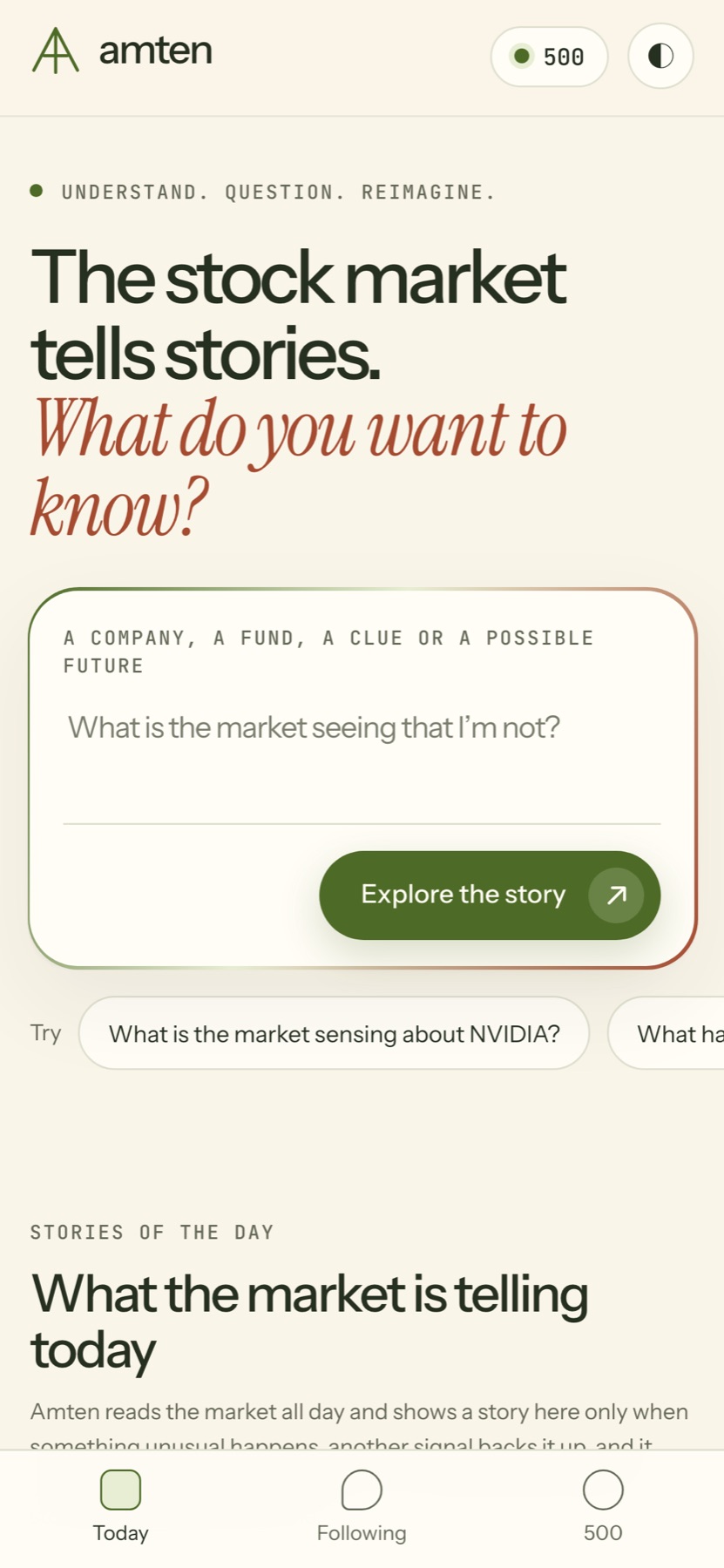
Every story is about a subject, and subjects combine, such as a company inside a macro scenario.
| Kind | Subject | Typically opens on |
|---|---|---|
| Company | A US-listed company | What the price needs, the crowd, the hidden cast, one future |
| Market / macro | The US market | The regime (rates, growth, inflation, risk appetite) and what the market is bracing for |
| Sector rotation | One sector or the whole map | Relative strength and momentum quadrants, with trails |
| Crowd | A company or a sector | What price action, options and owners say, separately and together |
| Fund | An ETF such as XLE | What the holdings add up to and what changed in them |
| Theme | A theme | Where institutional money is moving, and which companies sit in it |
| Question | Your words | The question's mechanism and what reaches whom |
| What-if | A shock and a scope | The shock, its path, who it reaches, whose story breaks |
The nightly refresh
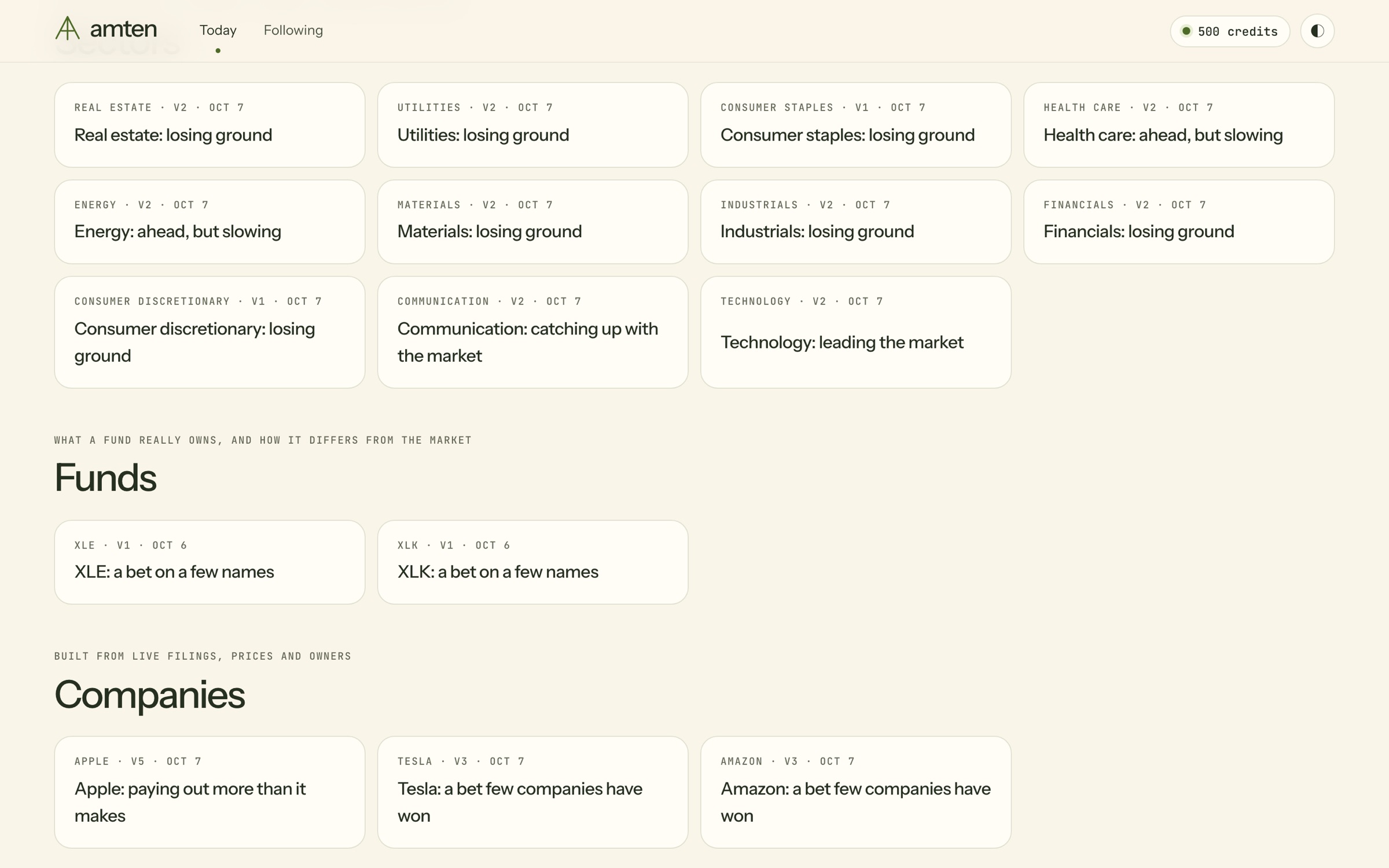
Apart from the Stories of the day, company stories for the ~300 most-followed or most-viewed US listings are refreshed every night, so the common reads open instantly and carry yesterday's close. If a refresh changes something material, followers get a new version with its diff.
Common questions
Why are there days with no stories?
Because the materiality test has no quota. A day where nothing is at least two standard deviations from its history, corroborated and consequential produces nothing, by design.
Can the same company be a story twice in a week?
Not for the same mechanism within 5 days: that updates the existing story as a new version. A different mechanism can start a new story.
Who chooses the ranking?
Code scores surprise, corroboration and consequence; one judgment scores newsworthiness. No writing model chooses what makes the list.
What does a Story of the day cost to read?
3 credits for most, never more than 25, once per version.